From a Kilowatt-Hour to the Next Power Plant

How Arkreen connects energy, revenue, and capital to help distributed infrastructure grow.
A solar panel turns sunlight into electricity. A battery carries that energy into the evening. A device delivers power to a household, a small business, or a workplace.
Around these physical activities, another system is at work. Someone provides the capital. Someone installs and maintains the equipment. Someone pays for the service. Someone carries the risk.
Together, these relationships determine whether an asset keeps operating, and whether the next one can be deployed.
Generating electricity creates value. Operating the asset, collecting revenue, and arranging suitable financing give that value a path to scale.
Arkreen's long-term vision is to build a distributed energy network with embedded finance at its foundation, connecting asset operations, transactions, settlement, and capital allocation.
In that network, a kilowatt-hour can deliver a useful service. A paid service can create a verifiable revenue record. A history of real operations can help support the next investment in infrastructure.
Finance belongs inside the energy product
In The Next Energy Unicorn Will Be a Trading Desk, Crucible Capital describes an emerging kind of energy company: one that combines credit, trading, and dispatch, with capital structure and risk management built into the business.
For Arkreen, this points to a practical direction. Financial capabilities should accompany an energy asset throughout its life, from deployment and daily operation to revenue distribution and reinvestment.
Financial design begins when the equipment is purchased. Initial funding, operator compensation, maintenance and replacement reserves, and the conditions for distributions to capital providers all need to be defined.
The answers shape the business as directly as its choice of solar panels, batteries, and control systems.
Embedded finance, in this context, means connecting the asset's daily activity with its revenue, responsibilities, and funding arrangements.
This matters especially for small assets. A large project can support dedicated teams for finance, operations, and maintenance. A community energy unit, a small battery installation, or a commercial rooftop still needs those functions, delivered at a cost its business can sustain.
Hardware can be manufactured repeatedly. The business around that hardware also needs a repeatable design.
Arkreen aims to provide shared capabilities that allow local operators to serve their customers, devices to produce reliable records, revenue to be settled under clear rules, and funding partners to understand how assets actually perform.
A small device can carry a complete energy business
Arkreen began exploring this path through renewable energy attributes. Its AREC work connects generation records with the verification, issuance, exchange, and use of environmental attributes. That experience established a foundation for connecting devices, data, and markets.
As the network extends into energy services, the evidence must become more complete. Generation, service delivery, payment collection, and revenue distribution are separate events. Connecting them creates a usable operating history.
eCandle makes that progression tangible. At TAS Hub in Awka, Nigeria, users can rent an eCandle by the hour, pay in stablecoins, and take energy into their daily work and lives. The pilot demonstrates a direct connection between an energy device and paid demand.
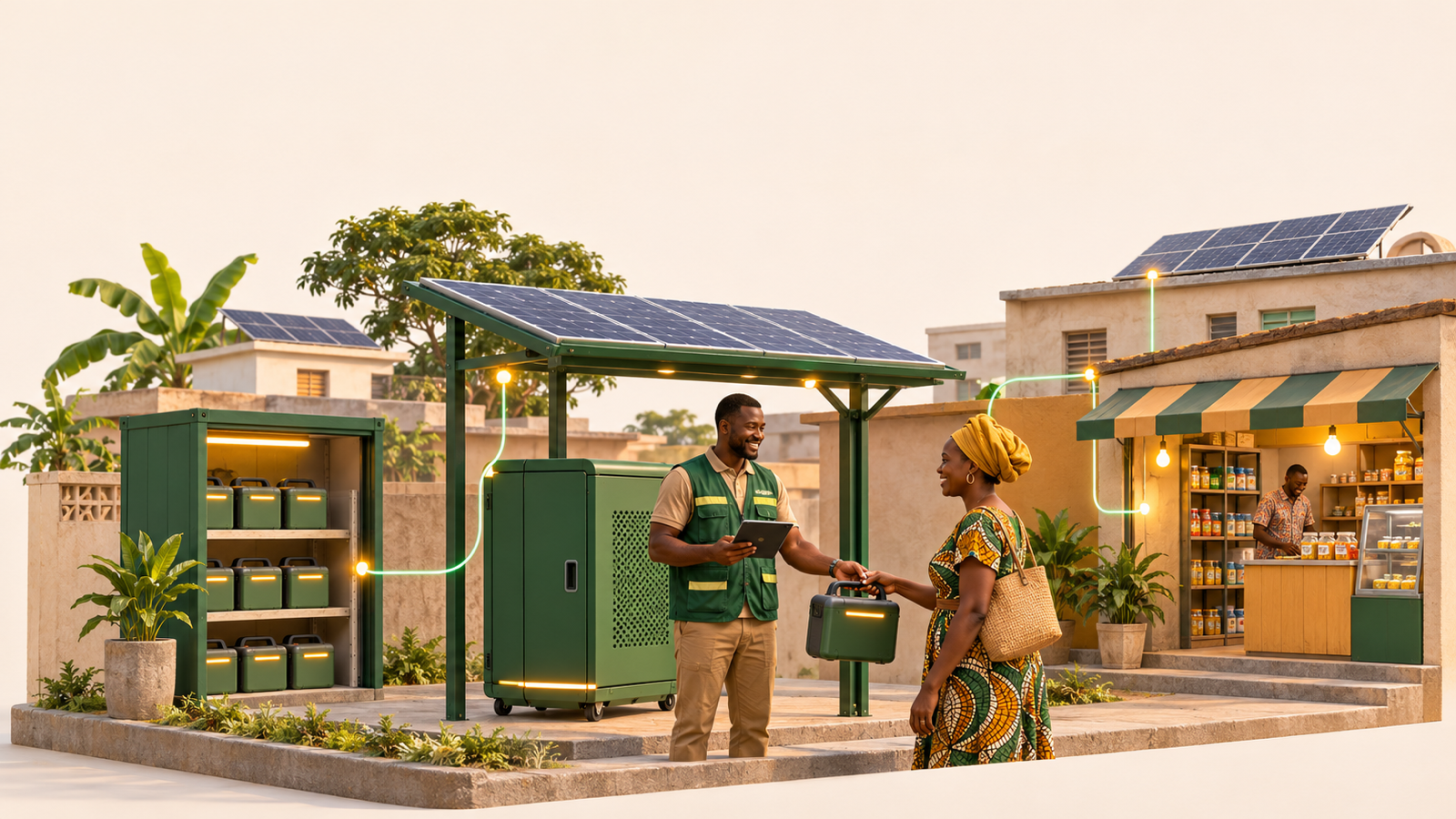
Concept illustration of a local energy business. The scene and equipment are illustrative, rather than a photograph or product rendering of the TAS Hub pilot.
Scaling that model requires a continuing understanding of the business: when equipment is used, whether customers keep paying, how quickly faults are resolved, whether revenue covers maintenance and replacement, and whether demand justifies more capacity.
Over time, those observations form a site's operating history. A strong site can use that history to support expansion. A weaker site may need a different configuration, service model, or operating approach. Growth should reflect what the network learns.
eCandle can therefore become a standardized unit of a small energy business. Local demand, local service, and external funding come together around clear responsibilities and revenue arrangements. The equipment delivers the physical service; the network helps coordinate the participants.
Commercial solar offers another application. PowerYield’s published rooftop-solar example connects metering with revenue distribution. EnergyFi is developing reusable capabilities for verification, asset organization, and settlement. Each application has its own customers, contracts, and operating conditions. Their shared requirement is evidence that can be traced to real assets and collected revenue.
Credit, trading, and dispatch
These applications point toward three capabilities that Arkreen aims to bring together over time.
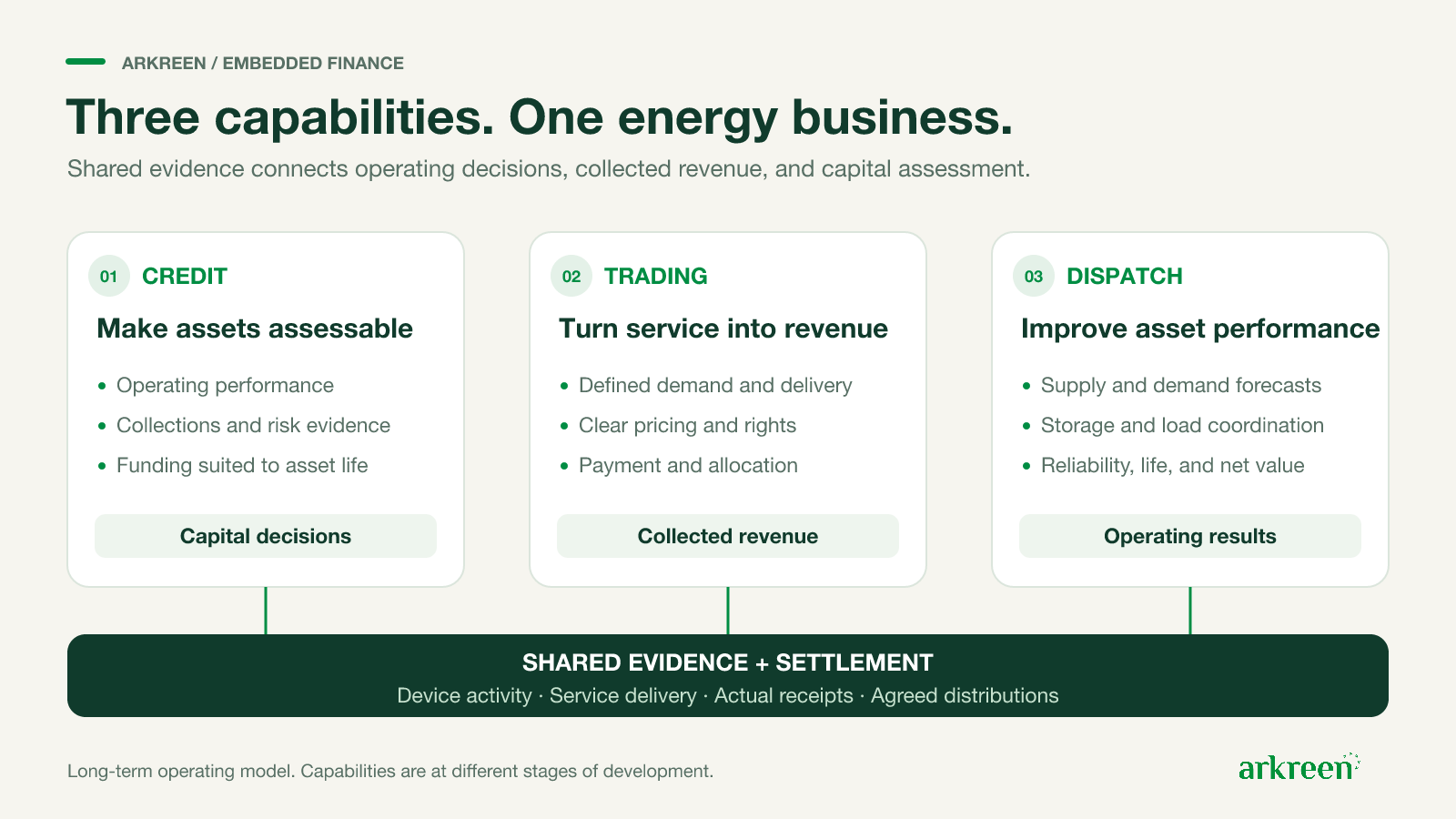
An operating model for the long term. Individual capabilities are at different stages of development.
A credit platform makes assets understandable and assessable. Operating history, actual collections, maintenance records, and contractual performance help funding partners evaluate a business. Better information can support financing terms that fit the asset's cash-flow pattern and useful life. Funding partners retain responsibility for their own credit and investment decisions.
A trading network organizes real supply and demand. Local energy services, renewable energy attributes, and, where market access permits, flexibility services each need a clear definition of what is delivered, how it is priced, and how it is settled. The rights being exchanged must be explicit, with each payment linked to the corresponding obligation.
A dispatch engine improves operating decisions. Solar output, customer demand, battery condition, and prices change over time. As control capabilities and market access develop, dispatch can coordinate storage, discharge, and flexible loads while respecting service reliability, equipment life, and cost.
The objective is better long-term operating performance. A decision that produces more revenue today can still be unattractive if it causes disproportionate battery wear or compromises the customer's energy service.
These capabilities reinforce one another. Dispatch improves asset performance. Transactions generate revenue. Operating records inform capital assessment. Capital supports further deployment.
They also need to share information. An equipment fault should inform maintenance and revenue expectations. A delayed payment should be visible before money is distributed. Sustained improvement should be available to the next assessment of the asset.
Stablecoins and programmable settlement can support this coordination by giving participants a common payment record and a way to execute agreed allocations. Device data supplies operating evidence. Reconciliation between the two helps explain where money came from and how it should be handled.
Capital structure is a product decision
Every asset needs funding with an appropriate duration, cost, and allocation of risk. Equipment life, seasonal revenue, payment behavior, and local maintenance capacity should influence how capital enters the project and how cash leaves it.
For the same physical asset, a better match between funding duration and useful life, or between repayment schedules and collected revenue, can change whether the project is viable.
Capital structure affects the operator's cash pressure, the price of the energy service, and the pace of expansion.
A well-designed energy product considers these conditions alongside hardware, software, and local service. Delivery of the equipment starts a relationship that may continue for years. Financing and distribution arrangements must serve that operating life.
Lower capital costs have to be earned through credible performance.
Reliable measurement helps explain what happened. Clear responsibilities help resolve problems. Consistent collections support more informed expectations. Timely maintenance reduces interruptions. Together, these capabilities give funding partners a stronger basis for assessing risk.
Whether this leads to better financing terms must be demonstrated through actual funding decisions and subsequent performance.
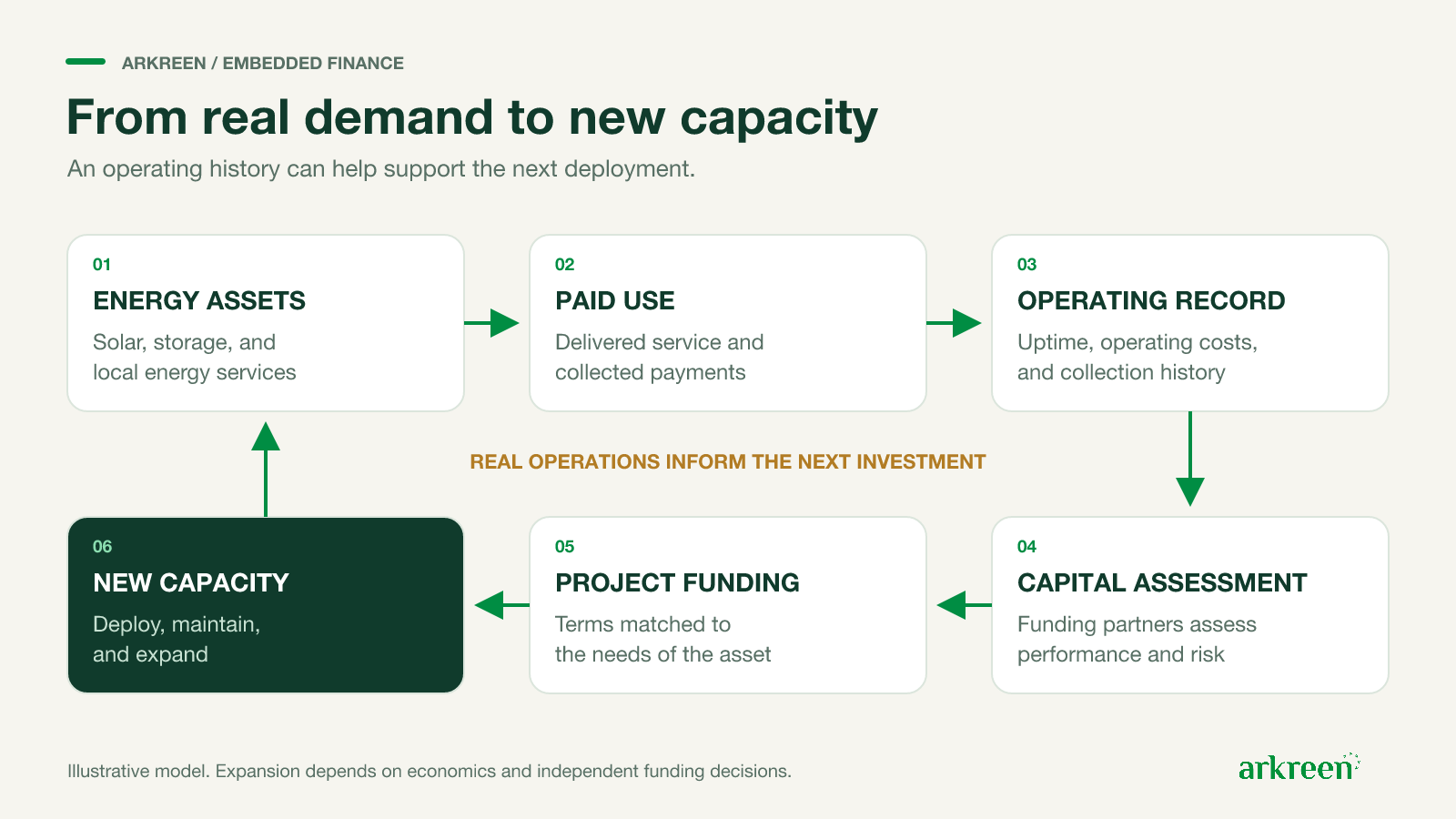
An illustrative growth model. Financing and expansion depend on asset economics, operating performance, and independent funding decisions.
Risk management becomes an operating capability
Risk management belongs in the daily operation of the network.
Automation can handle continuous monitoring, anomaly detection, reconciliation, and the execution of agreed rules. Local teams handle repairs, customer service, and physical conditions. Capital providers make decisions within their own responsibilities.
A useful system gives each participant earlier visibility into relevant problems and the information needed to act.
Assets retain their differences. Equipment reliability, operator quality, local demand, and collection behavior vary. Those differences should remain visible in the evidence used to make decisions.
Over time, dependable operators can build a record that follows their work. Equipment performance can be understood across deployments. Payment behavior can be evaluated across operating periods.
This is part of the durable advantage Arkreen aims to build: an accumulating history of real operations that improves the next deployment and the next assessment.
The progress of the network can be tested in concrete terms. Connected devices must become assets that deliver services. Services must result in collected revenue. Collections must support operating costs and equipment renewal. Operating histories must prove useful to subsequent funding decisions.
Arkreen's own business model should grow from these recurring activities. Asset onboarding, verification, operational support, settlement, and ongoing asset services can create durable service relationships. Where performance improvements can be measured, participants can also agree on how the benefits are shared.
The long-term health of the network depends on the businesses within it remaining viable.
An economic network that can grow
Arkreen's ambition is to give local operators a path to expand their businesses, equipment manufacturers a route into continuing service markets, and capital providers a clearer view of smaller energy projects.
Participants can contribute different capabilities while working from shared evidence and explicit responsibilities.
Electricity is produced and consumed in specific places. The knowledge, operating records, settlement capabilities, and capital relationships around it can extend beyond any one site.
This vision must be built through real applications. Renewable energy attributes, community energy, and commercial solar represent different stages of that work. Broader dispatch, credit support, and portfolio capabilities will develop alongside operating evidence, partners, and market conditions. Each expansion should bring an improvement that can be tested in practice.
Arkreen believes the next decade of energy competition will increasingly turn on this combination of capabilities: operating assets well, accessing capital at suitable cost and duration, and automating the work of managing risk.
The next generation of energy companies will need to understand equipment, customers, and capital together. They will design their financing structures with the same care they bring to their products.
Local demand creates an opportunity to serve. Continuing service produces revenue. A credible operating history helps organize capital. Capital supports the next deployment.
From a kilowatt-hour to a collected payment. From that operating history to the next device, the next community, and the next power plant.
Arkreen is building toward an economic network in which energy, revenue, and capital support the continuing growth of distributed infrastructure.
Follow the work or bring a project
For field reports from our energy projects, follow Arkreen on X.
If you run a hub or want to host a pilot, tell the eCandle team about your site using the “Talk to us” form. For a home or shop in Nigeria, compare solar kits and request an order. Developers working with verified energy data can request a place on the EnergyFi sandbox waitlist.